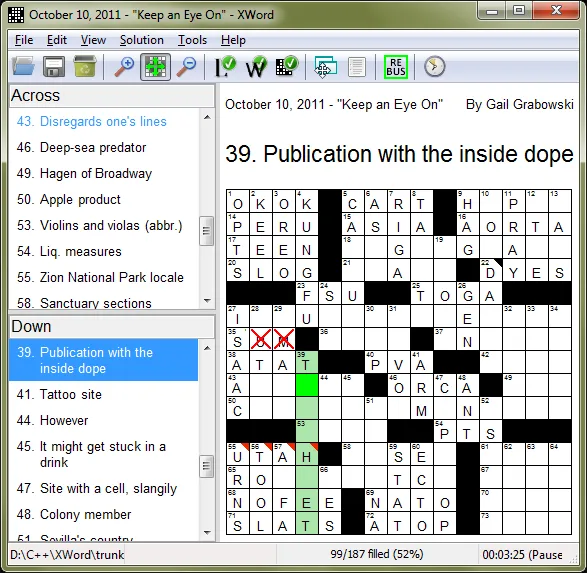
First run is about proof, not customization. Launch XWord from the Windows install or the macOS app. Use File, Open. Pick a small .puz. Watch the clue lists track the cursor as you move.
Checklist
- Launch XWord.
- Open a known
.puz. - Move through a few across and down entries.
- Save to a folder you control.
- Start and stop the timer once.
- Try check letter once on a throwaway copy if you want.
- Write the puzzle folder path on the ticket.
What to skip
Skip Package Manager. Skip heavy layout floating. Skip diagramless until a normal grid feels normal. First hour page: installed. Timer details: timer check reveal.
If the file will not open
Note the extension. Try another .puz. Check formats: formats. Prefer fixing the file choice before reinstalling the crossword client.
If the window looks empty
Confirm panes are visible. Upstream docs cover clue lists and layout. Prefer restoring a default layout before downloading a second binary from a random mirror.
Shared desk pin
Shared desks should pin the Releases URL beside the OS version. After every reimage, prove one local crossword open before workshops begin. Travel laptops should download once on a trusted network, then solve offline with puzzles already on disk.
Club download discipline
Club volunteers invent Softonic mirrors when a first launch is blocked. Prefer returning to GitHub Releases for mrichards42/xword instead. Write the exact filename on the machine ticket so the next bump stays honest for the whole room.
Classroom images
Classroom images drift when someone keeps a private copy of an old exe. Prefer the current tag that still ships XWord-Windows.exe and XWord-macOS.zip together. Linux builders should document their wxWidgets version beside the commit they built.
Family PCs
Family PCs benefit from a boring puzzle folder path. Keep Across Lite or a browser board as a fallback until the new window feels normal. Subscription newspaper apps remain optional for archives and are a different job than a local .puz client.
Publisher note
Across Bind publishes install maps for people who searched for crossword software. Upstream XWord remains GPL-3.0. When Releases change asset names, re-check the live list before you refresh a lab image.
Related
Desk logistics
- Ticket line: OS, asset name, puzzle folder
- Demo door: one official path for volunteers
- Travel rule: trusted network first
Write the OS version, asset name, and puzzle folder on one ticket line. Clubs should assign a single demo door so volunteers stop mixing Across Lite, browser tabs, and XWord without notes. Travel kits should carry puzzles on disk only when policy allows encrypted storage.
After the first week
Only then add Package Manager downloaders, heavy layout floating, or diagramless drills. Prefer one documented update habit. Re-check Releases whenever upstream publishes a new tag that still lists your OS asset.
More desk notes
Prefer one Releases bookmark in the browser profile used for installs. Refuse email attachments that claim to be a crossword updater. After every lab reimage, open one cached .puz before you call the image ready for students. Keep Across Lite only as a labeled fallback, never as a silent second installer path without a ticket note.
Shared room reminder
On shared crossword desks, prove File, Open on a known .puz after every reimage before you invite the next solver. Keep the Releases URL written in plain text beside the asset name so nobody invents a Softonic mirror under pressure.
Frequently asked questions
What file should I open first?
Start with a small Across Lite .puz you already trust. Prove the grid and clue lists before you try rebus, diagramless, or Package Manager downloads. Save once to a folder you control on disk.
Should I change colors first?
No. Prove one crossword open and one save before style preferences. Layout and color experiments are easier after the baseline path is boring for shared desks and classroom images that reimage often.
When do I use Package Manager?
After the first local puzzle works cleanly on disk. Tools, Package Manager can add downloaders later for clubs that want fetches. Keep GitHub Releases as the install door even when packages add optional puzzle sources for shared crossword desks.